
Last updated March 2026
Vitamin D3
Fireblood includes 2,000 IU of vitamin D3 as cholecalciferol, paired with vitamin K2 for proper calcium routing. An estimated 42% of US adults are deficient (Forrest & Stuhldreher, Nutrition Research, 2011), and D3 is roughly 87% more potent than the D2 found in cheaper supplements.
What vitamin D3 does
Vitamin D is technically a hormone precursor, not a vitamin. Your skin produces it from sunlight, but most people who work indoors, live above the 37th parallel, or have darker skin don’t produce enough year-round.
It controls calcium and phosphorus absorption from your gut. Without adequate D3, you absorb only 10-15% of dietary calcium. With adequate D3, that jumps to 30-40% (Holick, 2007, New England Journal of Medicine). This is why D3 and calcium are always discussed together.
D3 receptors exist in nearly every tissue in the body. Research links adequate vitamin D status to immune regulation (Aranow, 2011, Journal of Investigative Medicine), mood stability, and reduced risk of several chronic conditions. A 2017 meta-analysis in the BMJ found that daily or weekly vitamin D supplementation reduced the risk of acute respiratory infection by 12% overall, and by 70% in those who were severely deficient.
Why the form matters
There are two supplemental forms: D2 (ergocalciferol) and D3 (cholecalciferol). They are not equivalent.
A 2012 study in the American Journal of Clinical Nutrition (Tripkovic et al.) found that D3 was approximately 87% more potent than D2 at raising and maintaining serum 25(OH)D levels. D2 also has a shorter shelf life and degrades faster during storage.
D3 is what your skin produces naturally. D2 comes from fungi and yeast. Your liver converts both to 25-hydroxyvitamin D, but it processes D3 more efficiently. Most evidence-based practitioners recommend D3 exclusively.
Fireblood uses cholecalciferol (D3). Not D2.
Why Fireblood pairs D3 with K2
Vitamin D3 increases calcium absorption. Vitamin K2 directs that calcium to bones and teeth instead of soft tissues and arteries. Without K2, supplementing D3 at higher doses can lead to calcium depositing where you don’t want it.
Fireblood includes both K1 (120 mcg) and K2 as MK-4 (120 mcg) alongside D3. That way, the calcium you absorb actually ends up in your bones, not your arteries. Many D3 supplements skip K2 entirely, which is a real gap.
For more on why K2 matters, see our Vitamin K2 ingredient page.
Signs you might not be getting enough
- Fatigue that persists despite adequate sleep
- Bone or joint pain, especially in the lower back
- Frequent colds or infections
- Low mood, particularly in winter months
- Slow wound healing
- Muscle weakness or cramping
These symptoms overlap with other deficiencies (magnesium, iron, B12), which is why testing serum 25(OH)D levels is the only reliable way to know your status. Optimal range is generally 40-60 ng/mL, not just “above 20” which some labs flag as sufficient.
How much you actually need
The RDA is 600 IU (15 mcg) for adults, set to prevent rickets. Most vitamin D researchers consider this inadequate for optimal health. The Endocrine Society’s clinical guidelines suggest 1,500-2,000 IU daily for adults to maintain serum levels above 30 ng/mL.
The tolerable upper limit set by the NIH is 4,000 IU per day, though some studies use doses of 5,000-10,000 IU without adverse effects.
Fireblood provides 2,000 IU per serving. That sits at the upper end of the Endocrine Society’s recommendation and well within the safety limit. It is enough to meaningfully raise serum levels for most people, especially when combined with dietary sources and some sun exposure.
What Fireblood includes
2,000 IU (50 mcg) of vitamin D3 as cholecalciferol, paired with vitamin K1 (120 mcg) and K2 MK-4 (120 mcg). The D3+K2 pairing is intentional and something most standalone D3 supplements miss.
For a deeper dive on vitamin D supplementation, including timing, food pairing, and the D2 vs D3 debate, read our full article: Vitamin D: the most important supplement you’re still taking wrong.
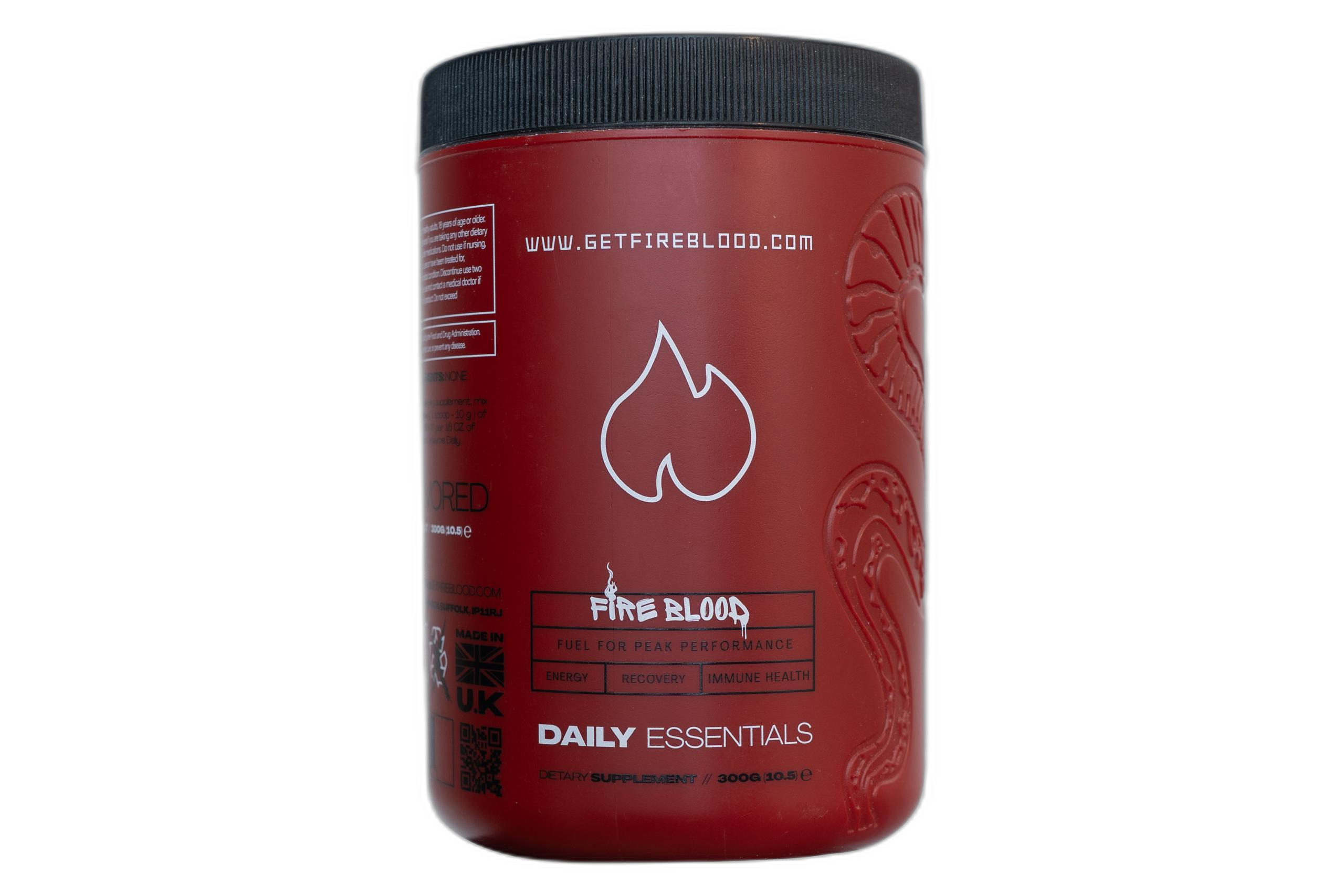
Fireblood includes vitamin D3 alongside 38 other ingredients, all with doses listed on the label. See the full formula.
 See the full formula