
Last updated March 2026
Stop buying 8 bottles. Cover the base in one scoop.
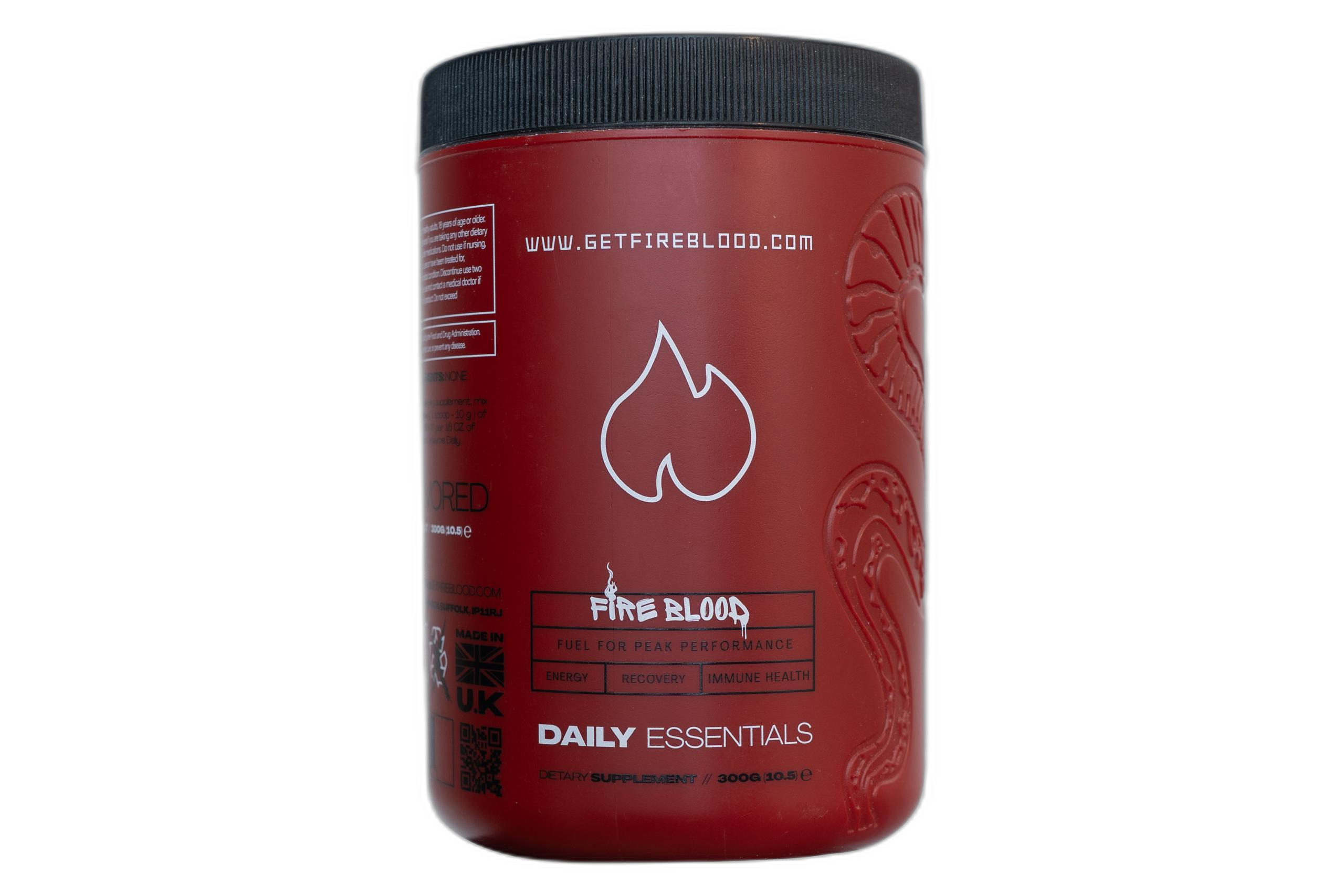
You know the drill. Protein powder. Aminos. Pre-workout. A multivitamin you forget half the time. Zinc, magnesium, vitamin D as separate bottles rattling around your kitchen. Add it up and you’re spending $150-200 a month before you even touch creatine. Fireblood is the foundation layer. One scoop covers your vitamins, minerals, and all 9 essential amino acids. You keep your protein. You keep your creatine. Everything else is handled.
What your supplement stack is actually costing you
Let’s do the math. Here’s what a typical gym-goer’s monthly supplement spend looks like if you’re buying decent brands, not gas station pills:
| Supplement | Monthly Cost |
|---|---|
| Protein powder | $40 |
| Pre-workout | $35 |
| BCAAs / aminos | $25 |
| Multivitamin | $20 |
| Zinc | $10 |
| Magnesium | $15 |
| Vitamin D | $10 |
| Total | $155/mo |
Fireblood replaces the BCAAs, multivitamin, zinc, magnesium, and vitamin D. That’s $80 worth of bottles replaced by a single product at $62/mo on the 90-day plan. You still need your protein. You still need your pre if you want caffeine. But you just cut five products down to one, and saved $18 a month doing it.
More importantly, you went from five different labels with five different quality standards to one label where every single dose is printed. No guessing.
EAAs vs BCAAs: the science is clear
BCAAs had a great marketing run. Leucine, isoleucine, valine. The “muscle-building” aminos. The ones you sip intra-workout in a neon-colored shaker.
Here’s the problem. There are 9 essential amino acids, not 3. Your body needs all 9 to build muscle protein. BCAAs are 3 of the 9. Taking them alone is like bringing 3 of the 9 players to a baseball game and expecting to field a team.
A 2017 study by Jackman et al. in Frontiers in Physiology tested this directly. They found that BCAAs alone stimulated 22% less muscle protein synthesis than a full essential amino acid profile. The BCAAs triggered the signaling pathway (mTOR), but without the other 6 EAAs present, your body couldn’t actually complete the job.
Fireblood includes all 9 EAAs. Not just the 3 that look good on a label. For the full breakdown, see our Essential Amino Acids ingredient page.
If you’re already eating 1g of protein per pound of bodyweight, you’re probably getting enough EAAs from food. But on days when your protein intake is lower, or if you train fasted, having the full EAA profile matters more than you think.
The minerals gym guys overlook
Everyone talks about protein. Nobody talks about zinc and magnesium until they can’t sleep or their lifts stall for no reason.
Zinc and testosterone. A 1996 study by Prasad et al. in Nutrition took healthy young men and restricted their zinc intake for 20 weeks. The result: serum testosterone dropped by 75%. Not a typo. Mild zinc deficiency, the kind you’d get from sweating heavily and not replacing it, crushed their testosterone levels. The same study showed that zinc supplementation in marginally deficient older men nearly doubled their serum testosterone over 6 months.
If you train hard, you lose zinc through sweat. A lot of it. The RDA (11mg for men) assumes you’re not drenching a t-shirt five days a week. Fireblood uses zinc bisglycinate, a chelated form your body actually absorbs well, rather than the cheap zinc oxide you’ll find in most multivitamins.
Magnesium and recovery. Magnesium is involved in over 300 enzymatic reactions. It matters for muscle contraction, nerve function, and sleep quality. A 2002 study by Held et al. in Pharmacopsychiatry found that magnesium supplementation increased slow-wave sleep (the deep, restorative kind) and reduced cortisol levels. Better sleep means better recovery. Better recovery means better gains. Simple.
Fireblood uses magnesium bisglycinate and magnesium malate. Both are chelated forms with high absorption. Not magnesium oxide, which is basically a laxative that your body barely uses. For the full science, see our magnesium and zinc ingredient pages.
Full label transparency (because you read labels)
You flip the tub around before you buy. You check the Supplement Facts panel. You look at doses. Good. You should.
Fireblood lists every ingredient and every dose. There are no hidden blends. No “muscle matrix” or “recovery complex” that lumps 8 ingredients into one number so you can’t tell what you’re actually getting.
Here are some of the key doses per serving:
Compare that to AG1 (Athletic Greens), which bundles ingredients into blends and doesn’t tell you how much of each you’re getting. You’re paying $79/mo and you can’t even verify the doses. We break that down in detail on our Fireblood vs AG1 comparison.
If you care about what goes into your body (and you’re reading this page, so you do), you deserve to see the numbers. All of them.
What Fireblood replaces (and what it doesn’t)
We’re not going to pretend Fireblood replaces everything. It doesn’t. Here’s an honest breakdown.
Fireblood replaces:
- Your multivitamin (39 ingredients, methylated B vitamins, chelated minerals)
- Your standalone B-complex
- Your zinc supplement
- Your magnesium supplement
- Your vitamin D supplement (2,000 IU D3 + K2)
- Your BCAA / amino acid powder (all 9 EAAs included)
Fireblood does NOT replace:
- Protein powder. You need 25-50g per serving. No powder-based supplement can include that much protein alongside 38 other ingredients and still taste drinkable. Keep your whey or plant protein.
- Creatine. Effective creatine dosing varies by bodyweight (3-5g/day for most people). We left it out intentionally so you can dose it properly. Take it separately.
- Pre-workout. Fireblood has zero caffeine. If you want stimulants before training, keep your pre. Fireblood is not a pre-workout and does not pretend to be one.
This is the point most supplement companies dodge. They want you to believe one product does everything. It can’t. Fireblood is the foundation. It covers your micronutrients and aminos. You build on top of it with protein, creatine, and caffeine if you want them.
How to fit it into your routine
Keep it simple. One scoop with breakfast. Every day, whether you train or not. Your body needs micronutrients on rest days too.
A sample daily stack:
- Morning: Fireblood with breakfast (covers vitamins, minerals, EAAs)
- Pre-workout: Your caffeine source of choice (Fireblood is not this)
- Post-workout: Protein shake (whey, casein, plant, whatever you prefer)
- Any time: 3-5g creatine monohydrate (timing doesn’t matter much, consistency does)
That’s it. Four products instead of eight. One scoop in the morning handles the base. The rest of your stack handles the performance-specific stuff.
Fireblood pairs well with food. The fat-soluble vitamins (D3, K2, vitamin A) absorb better with a meal that includes some fat. So take it with eggs, avocado toast, or whatever your breakfast looks like. Don’t take it on an empty stomach and wonder why it’s not sitting right.
You don’t need to cycle it. You don’t need a loading phase. Just take it daily and let the ingredients do their job over weeks and months. Micronutrient supplementation is a long game, not a single-session pump.
39 ingredients. Every dose on the label. No blends, no fillers, no caffeine. The foundation for everything else you take.
 See the full formula