Transparent Labs multivitamin review: 7 things to check before you buy
Transparent Labs Multivitamin is honest on the label but conservative on the doses. The vitamin D dose is half what most adults need in winter. The zinc dose is one third of the men’s RDA. The folate form is not specified. The capsule format leaves no room for amino acids, MSM, or electrolytes. If you already eat well, the gaps probably don’t matter. If you bought a multi because your diet isn’t perfect, they do.
The short version
- Vitamin D: 1,000 IU. The Endocrine Society suggests 1,500-2,000 IU for adult maintenance.
- Folate: 200 mcg DFE, form unspecified. Half the RDA. Cannot confirm methylated.
- Zinc: 3.8 mg per serving. Men’s RDA is 11 mg.
- B12: 2.4 mcg methylcobalamin. Correct form, RDA-floor dose.
- Format limit: capsule. No amino acids, no MSM, no electrolytes.
1. The vitamin D dose is on the low end
Transparent Labs Multivitamin contains 1,000 IU (25 mcg) of vitamin D3 per 4-capsule serving, in the VegD3 algae-derived form. The form is excellent. D3 is more effective than D2 at raising serum 25(OH)D, with a 2012 systematic review and meta-analysis showing D3 produces higher serum levels per equivalent dose (Tripkovic et al., 2012, American Journal of Clinical Nutrition).
The dose is the issue. The Endocrine Society recommends adults at risk of deficiency aim for 1,500 to 2,000 IU daily for maintenance, and notes that 600 IU is the floor for skeletal health, not the optimum (Holick et al., 2011, J Clin Endocrinol Metab). Most published deficiency data on adults show serum 25(OH)D below 30 ng/mL in the majority of the population through autumn and winter (Forrest and Stuhldreher, 2011, Nutrition Research).
1,000 IU will move the needle for someone who already gets reasonable sun. For a man living in the UK between October and March, it is not enough. Worth checking against your last blood result before you commit.
Fireblood includes 2,000 IU (50 mcg) of D3 in every scoop. Same form, double the dose.
2. The folate dose is unusually conservative
The label lists 200 mcg DFE of folate. The form, which is not specified beyond “folate,” is one of the few details the label does not break out. Most premium multivitamins now use L-5-methyltetrahydrofolate (the active form) and disclose it.
200 mcg DFE is exactly half of the historical RDA (400 mcg DFE) and roughly one third of what most multivitamins in this price tier use. It is also half the dose used in most of the trials that show meaningful homocysteine reduction (McNulty and Pentieva, 2008, Proceedings of the Nutrition Society).
If you carry an MTHFR variant, which roughly 40% of the population does in some form, low-dose folate without the methylated form is doing very little for you (Frosst et al., 1995, Nature Genetics). The label does not confirm whether the folate here is methylated, which is the question worth asking before buying.
Fireblood contains 667 mcg DFE as L-5-methyltetrahydrofolate, the bioavailable form, declared on the label.
3. The zinc dose is below the men’s RDA
Transparent Labs Multivitamin contains 3.8 mg of zinc per serving. The men’s RDA is 11 mg per day (NIH Office of Dietary Supplements, Zinc Fact Sheet). Population intake data shows zinc is one of the more commonly under-consumed minerals in adult diets, particularly among men whose food intake skews away from oysters, red meat, and pumpkin seeds (Wessells and Brown, 2012, PLoS One).
3.8 mg is not zero. It is about 35% of what an adult man needs, on the assumption that the rest comes from food. That assumption is fine if you eat a lot of red meat, oysters, or pumpkin seeds. It is less fine if you do not.
The wider point is that “covered by food” only works for nutrients you actually get from food. A multivitamin that delivers 35% of the RDA is supplementing the assumption, not the gap.
Fireblood contains 11 mg of zinc as zinc bisglycinate, which matches the RDA in a chelated form that absorbs at higher rates than zinc oxide or zinc gluconate.
4. The B12 form is right but the dose is at the floor
Methylcobalamin is the active form of B12, and Transparent Labs uses Re-Natured methylcobalamin at 2.4 mcg per serving. The form is correct. Methylcobalamin does not need to be cleaved like cyanocobalamin, which contains a cyanide molecule the body must remove before use.
2.4 mcg matches the adult RDA exactly. The issue is that B12 absorption falls with age, gut atrophy, PPI use, and metformin (Allen, 2009, American Journal of Clinical Nutrition). The NIH Office of Dietary Supplements B12 fact sheet notes that 10% to 30% of older adults absorb B12 from food poorly and may need crystalline B12 or B12-fortified foods. That is why supplemental B12 is typically dosed at 100 mcg or higher even though the RDA is 2.4 mcg.
2.4 mcg in the right form covers a healthy adult with normal absorption. It is not a buffer for someone whose gut is mid-decline.
5. There are no amino acids, no MSM, and no electrolytes
This is not unusual. Most capsule-format multivitamins skip these categories because they would push the capsule count from 4 to 12. The reason it matters is that “multivitamin” tends to be read as “complete daily supplement,” and a capsule multi rarely is.
The 9 essential amino acids, the 3 conditionally essential amino acids that affect collagen and sleep (glycine, taurine, proline), and the basic electrolytes (sodium, potassium, chloride) are usually absent. So is MSM, the joint and inflammation ingredient that needs gram-level dosing to do anything (Butawan et al., 2017, Nutrients).
This is not a Transparent Labs problem specifically. It is a structural limit of the capsule format. If your supplement stack already covers protein and electrolytes from other sources, this is a non-issue. If you assumed your multivitamin handled it, this is the gap.
Fireblood includes all 9 essential amino acids, glycine (1,000 mg), taurine (500 mg), proline (250 mg), 500 mg OptiMSM, and the full electrolyte set in every scoop. It can do this because it is a powder, not 4 capsules.
6. The capsule count is the daily friction nobody talks about
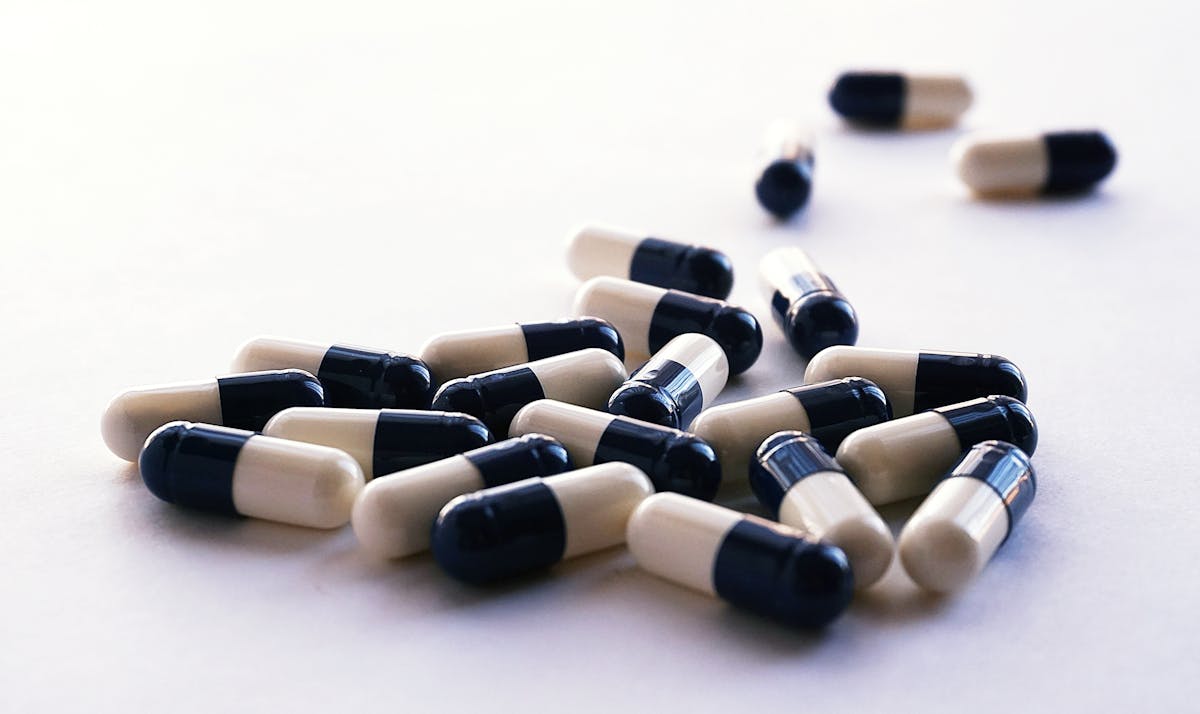
4 capsules a day, 120 per bottle, every day. The compliance data on capsule regimens is consistent across decades of research: adherence falls as the daily dose count rises, with the steepest drop-off when the regimen requires more than one swallow per day (Claxton, Cramer, and Pierce, 2001, Clinical Therapeutics).
4 capsules is not a deal-breaker for someone who already takes capsules. For someone who skips because the bottle is in the cupboard and they are running out of the door, it is.
The format choice is upstream of the formula choice. A capsule multi makes sense if you want portability and travel ease. A powder makes sense if you want bulk doses (gram-level amino acids and MSM) and a single scoop replacing eight bottles. Worth knowing what you are optimising for before you buy either one.
7. The plant-extract herbal blend is doing more marketing than nutrition
The formula includes a complex of extracts from annatto, sesbania, guava, holy basil, lemon, and amla, used as the carrier for the vitamin and mineral content. The framing is “whole food sources.” The reality is more mixed.
The plant extracts contribute small amounts of natural co-factors and phytonutrients. They are not a substitute for the underlying vitamin and mineral doses, which are still doing the work. The marketing language (“whole food multivitamin”) is doing more lifting than the extracts themselves at the doses present.
This is a common pattern in premium capsule multis. The named extract sounds compelling on the label but does not move the needle in the doses provided. It is not bad. It is decoration. If a multivitamin is selling you on the herbal complex more than the underlying doses, the doses are usually where the gap is.
The verdict
Transparent Labs Multivitamin is one of the more honest capsule multis on the market. The forms are mostly correct. The label is mostly transparent. The marketing is restrained compared to the proprietary-blend brigade.
The trade-offs are: a vitamin D dose that suits someone who already gets sun, a folate dose half what most adults need, a zinc dose at one third of the men’s RDA, and the structural limits of the capsule format (no amino acids, no MSM, no electrolytes). For someone who already eats well, sleeps well, and trains hard, those gaps may not matter. For someone who picked up a multi because the diet is not perfect, they probably do.
The label is the data. Read yours and then check what you are actually buying.
Fireblood is a 39-ingredient, fully-disclosed everyday formula. One scoop, every dose printed, no proprietary blends. See what’s in it.