
Last updated March 2026
The supplement most men over 40 are missing
After 40, your body absorbs less from food and processes nutrients differently. Stomach acid drops. Testosterone declines about 1% per year. Muscle protein synthesis slows. The multivitamin that worked fine at 25 is now fighting an uphill battle, and most of them were using cheap ingredient forms your body barely absorbed in the first place. The form of each nutrient matters more now than it ever did.
Why supplements matter more after 40
Your body at 42 is not the same machine it was at 25. That’s not motivation-poster talk. It’s gastric physiology.
Stomach acid production decreases with age. A study in the Journal of the American Geriatrics Society (Hurwitz et al., 1997) found that up to 30% of adults over 50 have atrophic gastritis, a condition that reduces hydrochloric acid output and makes it harder to absorb minerals like calcium, iron, and B12 from food. Your gut doesn’t extract what it used to.
Then there’s the hormonal side. Testosterone in men drops roughly 1% per year after 30 (Feldman et al., 2002, Journal of Clinical Endocrinology & Metabolism). That decline affects muscle retention, bone density, energy, and mood. Nutrients like zinc and vitamin D are directly tied to testosterone production. Running low on either puts you at a disadvantage your body is already fighting.
Sarcopenia, the age-related loss of muscle mass, starts in your 30s and accelerates after 40. You lose 3-8% of muscle mass per decade (Volpi et al., 2004, Current Opinion in Clinical Nutrition). Essential amino acids are the primary dietary driver of muscle protein synthesis, and most men over 40 aren’t getting enough, especially if protein intake has dropped.
Magnesium deserves its own mention. About 57% of adults don’t meet the adequate intake (King et al., 2005, Journal of the American College of Nutrition). Magnesium is involved in over 300 enzymatic reactions, including energy metabolism, protein synthesis, and sleep regulation. Low magnesium is also associated with higher cortisol, which accelerates muscle breakdown and fat storage.
The short version: your nutrient needs go up while your ability to absorb them goes down. That gap is where deficiencies hide.
What most multivitamins get wrong
Walk into any pharmacy and grab a men’s multivitamin off the shelf. Flip it over. You’ll probably see magnesium oxide, zinc oxide, cyanocobalamin, and folic acid. These are the cheapest possible forms of each nutrient. They’re cheap for a reason.
Magnesium oxide has an absorption rate of roughly 4% (Firoz & Graber, 2001, Magnesium Research). Four percent. You’re swallowing 400mg and your body is using about 16mg. It’s filler with a label claim. Fireblood uses magnesium bisglycinate and magnesium malate, chelated forms that are absorbed at significantly higher rates because they’re bound to amino acids your gut already knows how to process.
Cyanocobalamin is synthetic B12 that requires your liver to strip off a cyanide molecule (yes, an actual cyanide molecule) and convert it to the active form. If you have MTHFR gene variants, which roughly 40% of the population does, that conversion is impaired. Fireblood uses methylcobalamin, the form your nervous system actually uses. No conversion needed.
Folic acid is synthetic folate. About 40% of people cannot efficiently convert it to 5-MTHF, the active form (Crider et al., 2012, American Journal of Clinical Nutrition). Unmetabolized folic acid can accumulate in the bloodstream. Fireblood uses 5-MTHF directly, bypassing that bottleneck entirely.
Zinc oxide has lower absorption compared to chelated forms. Fireblood uses zinc bisglycinate, which a 2014 study in the Journal of Nutritional Science found to be 43% better absorbed than zinc gluconate. The form matters.
For B6, most supplements use pyridoxine HCl. Your body then has to convert it to P5P (pyridoxal 5′-phosphate) to actually use it. Fireblood includes P5P directly. This matters more as you age because the conversion pathway becomes less efficient.
The pattern is clear: cheap supplements use forms that require your body to do extra conversion work. After 40, your body is worse at that work. It’s the worst possible combination.
The ingredients that matter most after 40
Out of Fireblood’s 39 ingredients, these are the ones that become especially relevant once you pass 40.
Zinc (as bisglycinate) plays a direct role in testosterone production. A well-known study by Prasad et al. (1996, Nutrition) showed that zinc restriction in young men reduced testosterone by 75% over 20 weeks. It’s also essential for immune function, wound healing, and protein synthesis. The RDA is 11mg for men. Fireblood includes 15mg as zinc bisglycinate, a chelated form with superior absorption.
Magnesium (bisglycinate + malate) is the mineral most men over 40 are short on. It governs sleep quality, muscle recovery, blood pressure regulation, and energy production. Cinar et al. (2011, Biological Trace Element Research) found a significant correlation between magnesium status and testosterone levels in men, particularly in those who exercise. Fireblood includes two forms: bisglycinate for absorption and malate for cellular energy production.
Vitamin D3 (2,000 IU as cholecalciferol) is deficient in an estimated 42% of US adults (Forrest & Stuhldreher, 2011, Nutrition Research). After 40, your skin becomes less efficient at producing D3 from sunlight. Low D3 is linked to lower testosterone, weaker bones, impaired immunity, and fatigue. Fireblood pairs D3 with vitamin K2 to ensure calcium goes to your bones, not your arteries.
B vitamins (P5P, methylcobalamin, 5-MTHF) are involved in energy metabolism, red blood cell production, and cognitive function. B12 absorption from food drops significantly after 50 because of declining stomach acid and intrinsic factor production (Allen, 2009, American Journal of Clinical Nutrition). Taking methylated forms bypasses the absorption and conversion problems that become more common with age.
Essential amino acids (all 9 EAAs) are the building blocks your body cannot make on its own. After 40, you need more protein per meal to trigger the same muscle protein synthesis response you got in your 20s. This is called anabolic resistance (Burd et al., 2013, Journal of Nutrition). Fireblood includes all nine EAAs in every scoop, providing the raw material your muscles need to recover and rebuild.
Vitamin C (500mg) supports immune function, collagen production, and acts as an antioxidant. After 40, oxidative stress increases and your body’s ability to repair tissue slows. Getting enough vitamin C from diet alone is harder than most people think, especially under stress.
How Fireblood compares to a typical supplement stack
Most guys over 40 who take their health seriously end up with a kitchen counter full of bottles. Multivitamin, vitamin D, magnesium, zinc, B-complex, aminos. Each bottle is a separate purchase, a separate dose to remember, and a separate cost.
Here’s how that compares to one scoop of Fireblood.
| Nutrient | Fireblood | Separate stack |
|---|---|---|
| Chelated minerals (Mg, Zn) | ✓ Included | $15-25/mo |
| Methylated B vitamins | ✓ Included | $15-20/mo |
| Vitamin D3 + K2 | ✓ Included | $10-15/mo |
| All 9 EAAs | ✓ Included | $30-45/mo |
| Vitamin C (500mg) | ✓ Included | $8-15/mo |
| 27 additional ingredients | ✓ Included | $50+/mo |
| All doses on the label | ✓ Yes | Varies |
| One scoop, done | ✓ Yes | 6-8 pills daily |
| Monthly cost | $62/mo | $150+/mo |
Fireblood price reflects the 90-day plan. 30-day plan is $72/mo. Single can is $90.
Price aside, the convenience factor matters. Compliance drops when you’re managing multiple bottles and pill schedules. Research on supplement adherence (Bailey et al., 2013, Journal of Nutrition) consistently shows that simpler regimens lead to higher long-term consistency. One scoop in water beats a handful of capsules every morning.
What’s actually in each scoop
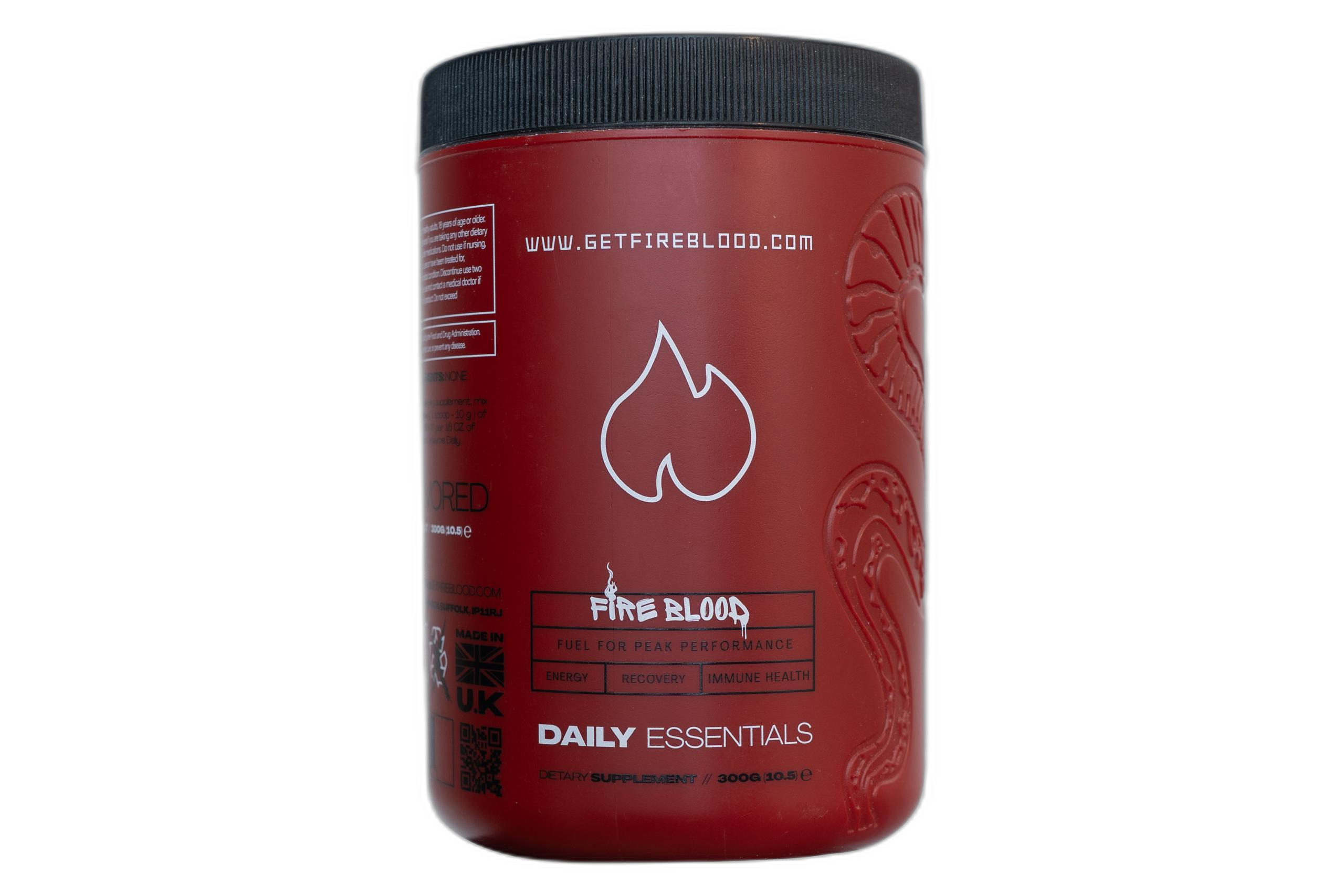
Fireblood contains 39 ingredients across vitamins, chelated minerals, and essential amino acids. Every single dose is printed on the label. No hidden blends disguising a total weight that tells you nothing.
The full ingredient list includes vitamins A, C, D3, E, K1, K2, B1, B2, B3, B5, B6 (as P5P), B7, B9 (as 5-MTHF), and B12 (as methylcobalamin). Minerals include calcium, magnesium (bisglycinate + malate), zinc (bisglycinate), selenium, manganese, chromium, and molybdenum. All nine essential amino acids are included: leucine, isoleucine, valine, lysine, threonine, methionine, phenylalanine, tryptophan, and histidine.
You also get choline (as phosphatidylcholine), vitamin C, and additional compounds for recovery and daily function. Every ingredient has a specific purpose. Nothing is there for label decoration.
For a detailed breakdown of each ingredient with dosing, forms, and the research behind them, visit the full ingredients hub.
Real talk: is it worth it?
Honest answer: it depends on you.
If you eat a perfectly balanced diet, get regular bloodwork, never miss a meal, and individually supplement based on your specific deficiencies, you might not need Fireblood. Some guys dial in their nutrition to that degree. Most don’t.
For the majority of men over 40 who are juggling careers, families, training (or trying to get back to training), and the general chaos of daily life, gaps exist. You skip meals. You eat the same rotation of foods. You haven’t had bloodwork done in two years. You take a cheap multivitamin and assume it’s covering you, but you still feel sluggish by 3pm.
Fireblood doesn’t replace eating well. It fills the gaps that eating well still leaves behind, and it does it with forms your body can actually process. Chelated minerals instead of oxides. Methylated B vitamins instead of synthetic junk. Real amino acids, not just a protein claim.
At $62 a month on the 90-day plan, it costs less than what most guys spend on a single bottle of good magnesium plus a separate B-complex. And it covers 39 ingredients in one scoop.
You’ll know within 30 days if you feel a difference. Most guys notice sleep quality first, then energy, then recovery. That’s the magnesium, B vitamins, and aminos doing their job.
No one’s going to pressure you into it. Read the label. Compare the forms. Check the doses. The information is all there because we put it there.
39 ingredients. Every dose on the label. One scoop. See exactly what’s inside.
 See the full formula